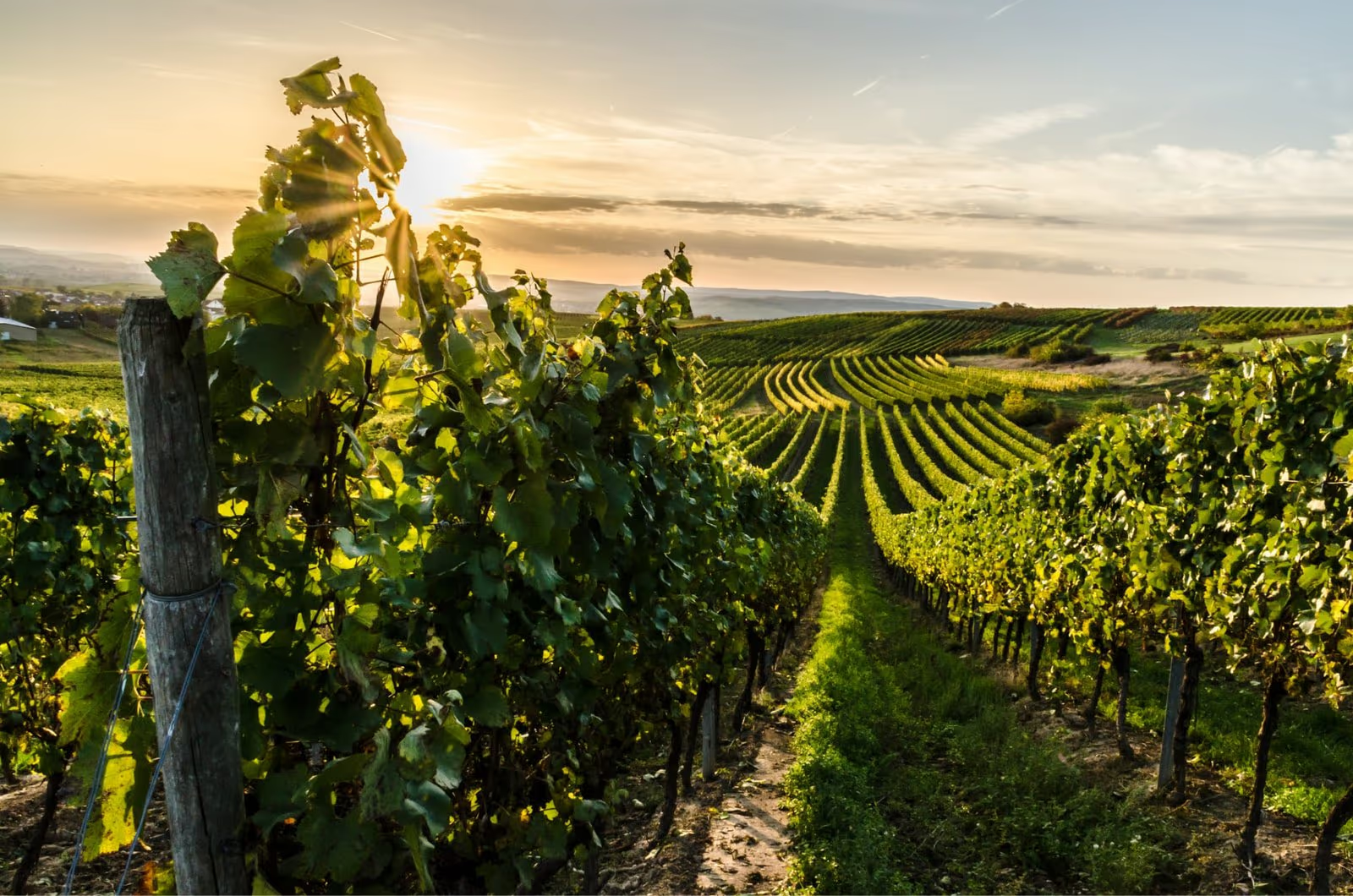
On a restaurant list as on a wine shop shelf, champagne has long been a matter for the big houses: a few brands known to everyone, reassuring, sold everywhere. Grower champagne tells another story. It is made by the person who farms the vines, often on a few hectares around a single village, and it offers the trade buyer what a big brand cannot give: a bottle that their customer will not find in the supermarket, with a terroir story to pass on. Here is how to recognise it, choose it and make room for it in your offer.
Grower or house champagne: what changes
Champagne has around sixteen thousand winegrowers and a few hundred houses. Yet most of the big houses own few vines in relation to their volumes: they buy most of their grapes from winegrowers, then blend wines from many villages to obtain a consistent style, year after year.
The winegrower who makes their own champagne does the opposite. They work their vines, press their grapes, vinify, bottle and sell under their own name. Their wines bear the imprint of a place (a slope, a village, sometimes a parcel) and of a hand. From one estate to another, styles vary far more than from one big brand to another.
For a buyer, this translates concretely:
- Singularity: cuvées that few of your competitors offer.
- A story: the village, the grape varieties, the work in the vineyard, which the team can tell in the dining room or at the counter.
- Value for money that is often favourable, without the weight of a big brand's marketing.
Reading the label: RM, NM, RC and the others
Every bottle of champagne carries, in small print, two letters followed by a registration number. This professional status indicates who made the wine:
- RM, récoltant-manipulant: the winegrower makes their own champagne from the grapes of their vines. It is the surest sign of grower champagne.
- RC, récoltant-coopérateur: the winegrower entrusts their grapes to their cooperative, which makes the wine; they then market it under their own brand.
- SR, société de récoltants: a company of winegrowers, often from the same family, who make the wine of their vines together.
- CM, coopérative de manipulation: the cooperative makes and markets the wine under its own brands.
- NM, négociant-manipulant: a house that buys all or part of its grapes or wines to make its champagne. The big houses are NM.
- ND, négociant-distributeur: it buys already-made bottles and markets them under its brand.
- MA, marque auxiliaire: a brand belonging to a buyer, a retail chain for example, made by a third party.
The status does not say everything about quality: there are excellent cooperatives and very fine small houses. But it says who stands behind the bottle, and that is precisely what a curious customer will ask you.
What to look at before listing
The village and the cru
Champagne classifies its communes: seventeen villages have grand cru status, around forty premier cru. This classification tells you about the reputation of the terroir, not the talent of the winegrower; a fine champagne from an unclassified village can outdo a less well-worked grand cru. Above all, remember the origin: the Montagne de Reims, the Vallée de la Marne, the Côte des Blancs or the Côte des Bar do not give the same wines.
The grape varieties
Three grape varieties dominate: Chardonnay, Pinot Noir and Meunier. A blanc de blancs comes from Chardonnay alone, often taut and chiselled; a blanc de noirs is born from Pinot Noir, Meunier or both, with more vinosity. Most cuvées remain blends. Long sidelined, Meunier is today championed by many winegrowers of the Vallée de la Marne.
Cellar time and the disgorgement date
A non-vintage champagne must age at least fifteen months in the cellar before being marketed, including twelve on the lees; a vintage, at least three years. Many winegrowers go well beyond, and it is a selling point. More and more labels also indicate the disgorgement date: valuable information for managing your stock and for talking about the wine.
The dosage
Dosage is the quantity of sugar added after disgorgement. It determines the term shown on the label:
- Brut nature: less than 3 g/l, no added sugar.
- Extra brut: from 0 to 6 g/l.
- Brut: less than 12 g/l, the most common term.
- Extra dry: from 12 to 17 g/l.
- Sec: from 17 to 32 g/l.
- Demi-sec: from 32 to 50 g/l.
- Doux: more than 50 g/l.
Winegrowers are moving more and more towards low dosages, which let the grape speak. At the table, an extra brut readily accompanies seafood and fish; a demi-sec keeps its place at dessert.
Building a coherent champagne offer
No need to line up ten champagnes. A tight offer, built by styles, sells better and is easier to explain:
- An entry-level brut, consistent, for the glass and the aperitif.
- A blanc de blancs or a blanc de noirs, for those who want to go further.
- A rosé, increasingly in demand. In Champagne, it can be born from a blend of white and red wine, or from a saignée.
- A more ambitious cuvée (vintage, single-parcel, long ageing) for great occasions.
In restaurants, champagne by the glass is an excellent lead product, provided you sell the bottle quickly or equip yourself with an airtight stopper. To integrate it into your price grid, our method for building a restaurant wine list details the markups and the logic of the glass.
A word on the calendar: the end of the year concentrates a large share of champagne sales. Winegrowers produce limited volumes, and their most sought-after cuvées go early. Order for the festive season as early as autumn, and plan your restocking rather than counting on a mid-December delivery.
Grower champagnes to discover on Cepino
The Cepino catalogue brings together around fifty Champagne estates, of every sensibility. A few examples to start with:
- Organic: Champagne Fabien Bergeronneau, Champagne Jeaunaux-Robin.
- Biodynamic: Champagne Régis Poissinet, Champagne Schreiber.
- Grand cru: Champagne Patrick Soutiran, Champagne Tornay-Hutasse.
- Premier cru: Champagne Autreau de Champillon.
To find out what these approaches cover, our guide to organic, HVE and biodynamic labels takes stock. And to compare styles side by side, nothing replaces tasting: the Cepino trade tastings bring together winegrowers from every region every month in Paris, Champagne included, with free access for trade buyers. The rest of the catalogue can be browsed on the Our estates page.
In summary
Grower champagne is recognised first by its label (above all the RM code), then by its origin, its grape varieties, its cellar time and its dosage. For a wine shop owner or restaurateur, it is the chance to offer sparkling wines that are not found everywhere, with a story to tell and often better value for money. Build a short, legible offer, order early for the festive season, and choose your winegrowers like your other estates: by tasting, and by meeting them.
More from the journal